A scheduler can say scheduled, failed, or even published without answering the operator's most important question: what exists on the social network right now?
The free Social Publishing Proof Checker turns five observable fields into one of four deterministic next actions. It is designed for the minute before a retry, when a missing response could mean a definite failure, a delayed job, a partial success, or an already-public post.
This guide explains the operating method behind the checker. It does not reproduce the tool page. Use the article to understand what each field can prove, then use the checker as a compact worksheet during an incident.
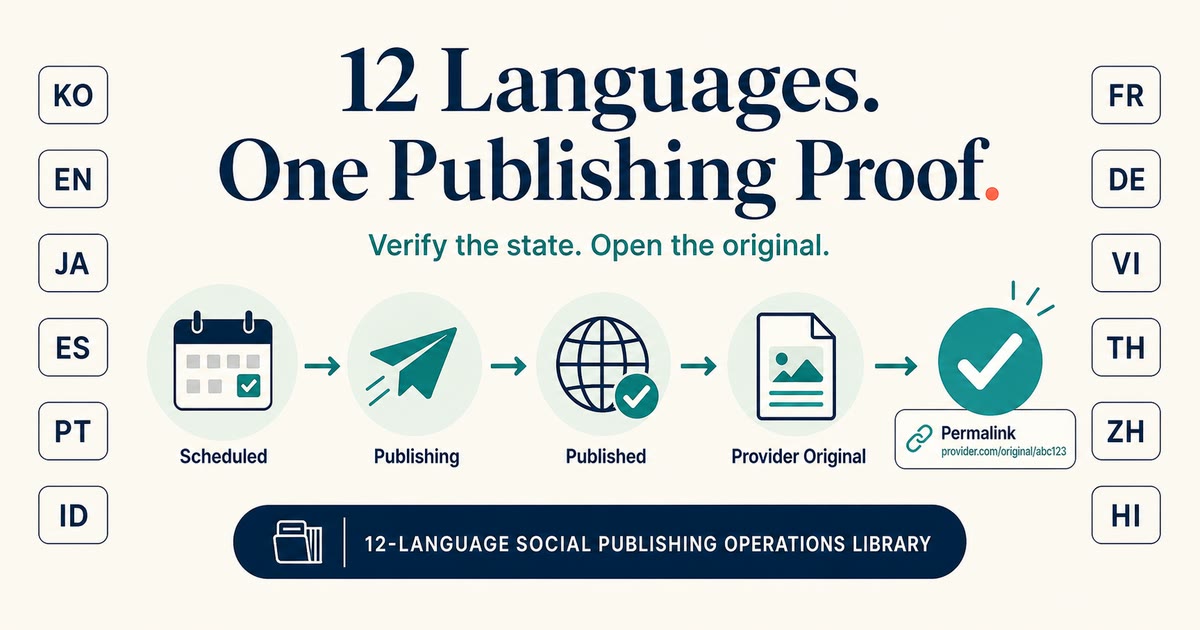
Why a status label is not enough
A status belongs to one system at one moment. The public result belongs to the social provider. Those two surfaces can disagree without either screen telling the whole story.
scheduled proves that a time was stored. publishing proves that work is in progress. failed proves that a component reported failure, but it does not always prove that the provider created nothing. published is stronger, yet operators may still need to verify the account, root-and-reply structure, media, and clickable links on the provider original.
The safe unit of evidence is therefore not a single status. It is a row that joins the scheduler record to the audience-facing provider object.
The five inputs to record
The checker asks for five groups of evidence. They are intentionally small enough to collect in about a minute.
- Channel and account. Name the destination and the public identity you expected. A correct post on the wrong account is not confirmed.
- Scheduled time. Include the timezone. This distinguishes a job that is early, late, or outside the expected verification window.
- Content or job ID. Use the stable identifier that lets you inspect the same request instead of creating a replacement.
- Last recorded status. Enter the latest state you actually observed, such as
scheduled,publishing,published, orfailed. - Provider URL and public outcome. Record the original URL when available and describe what is visible: correct, partial, missing, private, or unknown.
Do not paste passwords, access tokens, private prompts, unpublished client data, or signed upload URLs. The useful evidence is operational metadata and public-provider state.
Four deterministic outputs
The same five inputs should lead to the same output. The checker does not guess why an incident happened; it chooses the safest next verification step.
| Output | When it applies | Next action |
|---|---|---|
| Confirmed | Terminal success, correct account, stable ID, and matching public original | Preserve the evidence row; do not repost |
| Reconcile before retry | A failure or missing response could coexist with a provider object | Recheck the same ID, account, and provider original before creating anything |
| Wait | The job is scheduled or processing and the expected window has not closed | Set a next check time and keep the same ID |
| Hold — unknown | Key fields are missing or the public result cannot be determined | Stop automated recovery and collect evidence |
These are operational decisions, not predictions. Hold — unknown is useful because it prevents uncertainty from being silently rewritten as failure.
A Facebook false-negative scenario
Consider an automation history that shows one run while Facebook shows two provider posts. A slow or lost client response can make one create look unsuccessful even when the provider accepted it. An automatic retry may then create a second provider object.
That sequence is a plausible false-negative pattern, not a diagnosis by itself. Two public post IDs prove two provider-side objects; they do not identify which actor sent the second create. Preserve both permalinks, both timestamps, the automation execution ID, retry history, and any returned provider ID before changing the workflow.
The checker should return reconcile before retry when the client says failure but a provider object may exist. A second create is not a diagnostic test.
Root and reply need separate proof
A thread is not one indivisible result. The root can publish while a reply containing a link fails. Calling the whole thread successful hides the missing reply; calling it entirely failed hides the live root and invites a duplicate replay.
Record the root and reply as separate provider objects. If the root is public and the reply is missing, the accurate public outcome is partial. Recovery should target only the unresolved segment after checking whether a delayed reply already exists.
This is why the provider URL field matters even when a dashboard offers a single green or red badge.
Visible URL text is not proof of a clickable link
A provider original may contain the exact URL string while rendering no clickable anchor. Conversely, a platform may wrap the link in a redirect while still sending visitors to the correct destination.
Verification should separate three questions:
- Is the approved URL text present?
- Is there an actual clickable link carrier?
- Does the decoded destination match the intended URL?
Published answers none of those presentation questions on its own. If the link is part of the intended result, include clickability in the public-outcome field.
The 60-second workflow
- Open the scheduler record and copy the channel/account, scheduled time, stable content or job ID, and latest status.
- Open the provider original if a URL exists. Check the account, content, root/reply structure, media, and link presentation.
- Select the observed public outcome. Use
unknownwhen you cannot prove a result. - Read the deterministic output: confirmed, reconcile before retry, wait, or hold unknown.
- Save the evidence row with the observation time. Retry only after the row proves that no conflicting provider object exists.
Open the free Social Publishing Proof Checker
The checker runs locally in your browser. It requires no login and transmits no entered data. Reloading the page clears the worksheet, so copy the result into your own incident record if you need to retain it.
Frequently asked questions
What does “confirmed” mean?
Confirmed means the terminal state, expected account, stable content or job ID, and public provider original agree. It does not mean every campaign goal succeeded. Engagement, clicks, and conversions are separate measurements.
Should I retry whenever the scheduler says failed?
No. First check whether a provider ID, permalink, or matching public post already exists. A failed client response can coexist with a successful provider create. Retry only the unresolved destination or segment after reconciliation.
Does the checker connect to or publish on social networks?
No. It is a browser-local worksheet. It does not connect accounts, generate content, schedule posts, publish, or send the evidence you enter.
What if there is no provider URL?
Use the stable content or job ID to inspect the same operation. If the ID is also missing and the public result cannot be determined, choose hold unknown rather than creating another post.
How ANKK fits into this workflow
I am Minho Jung, the operator building ANKK. ANKK is not a built-in AI generator. It connects content prepared by people, external AI tools, or scripts to multi-channel scheduling, terminal publishing states, and provider-original verification.
The free checker is a separate, local-only decision aid. ANKK is the operating layer for teams that need to connect those evidence checks to recurring social publishing workflows.
See ANKK's scheduling and provider-verification workflow
Execution contract
- Body H1 count: 0
- Inline images: 1 exact public OG URL
- Clean checker URL: 1
- Campaign CTA: 1 unique UTM
- Native FAQ schema: unknown; FAQ answers remain structured in the body
- Create/update/publish: at most 1 each; ambiguity means no retry