When a scheduled post shows failed, the useful question is not only whether an error occurred. Ask: what exists on the public social account now? Resending without checking can create a duplicate, while waiting without recording evidence can hide a real failure.
The free Social Publishing Proof Checker turns five observable facts into four next actions: confirmed, wait, reconcile before retrying, or hold for missing data. It does not guess the cause and it does not publish anything. It helps you choose the safest next step.
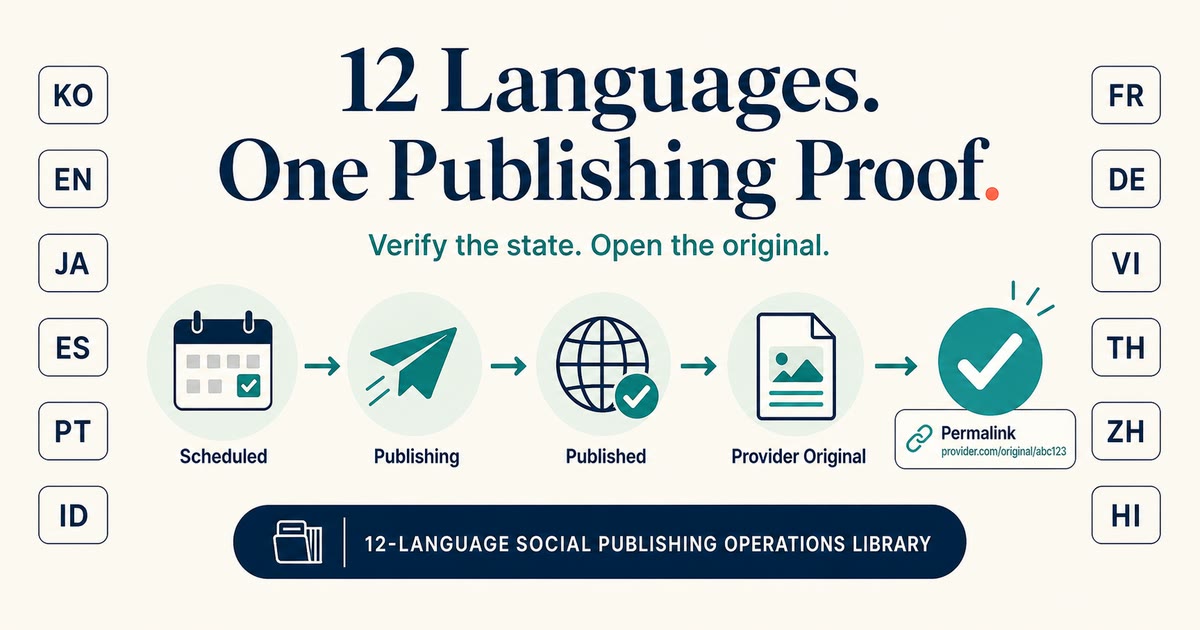
Why “failed” doesn’t prove the post is missing
A scheduling tool's dashboard shows the last state it was able to record. The public page shows the result that a person can see. These two signals may diverge due to delay, timeout, lost response or partial publication.
A response error may occur after the social network has created the post. It can also occur before any requests reach the provider. Without a stable ID or a reading of the original post, the two cases look the same on the dashboard but require opposite actions.
Therefore, the internal state should never be used alone to authorize a new send.
Five pieces of evidence that fit in a row
Log one line per publishing attempt:
- Channel and account: expected social network and public handle.
- Scheduled time: complete instant, with date and time zone.
- Content or job ID: stable identifier of the same operation.
- Last observed state:
scheduled,publishing,published,failedor other exact value. - Original URL and public result: correct, partial, missing, private or not yet verified.
Do not include a password, token, private prompt, customer data or signed URL. The evidence spreadsheet needs operational and public outcome metadata, not credentials.
Compare the same instant, not just the clock
A team in Brazil can plan in Brasilia time while the panel registers UTC. Comparing just “15:30” with “18:30” produces a false mismatch. Store the time zone with the time zone or normalize both to an ISO format before deciding that the job is late.
Also check the date change. A nightly schedule can appear the next day in UTC without having changed instantaneously. The verifier needs to receive the time of the operation being audited, not a visual approximation.
Result 1: confirmed
Use confirmed when count, time, ID, terminal state, and original publication match.
The visible text is only part of the proof. If the post depends on a video, image, threaded response or link, check these elements in the original. A URL written in the caption is also not necessarily a clickable link.
When everything matches plan, save the line of evidence and end the operation. Do not resend.
Result 2: wait
Use wait when the job is still in scheduled or publishing, the expected time has not expired and there is an ID that allows you to follow the same operation.
Set the next check time. “Waiting” without a deadline is abandonment; waiting with ID, last update and revision time is a controlled operational action.
Do not press publish again while the same job may still reach a terminal state.
Outcome 3: Reconcile before retrying
Use reconcile before resubmit when the dashboard indicates failure but there is still a sign that a public object may have been created.
Open the correct account and look for the post in the expected range. Compare text, media, time, and provider ID when available. If a part was published, record the case as a partial result rather than making the whole thing a success or failure.
In one observed execution, one channel showed the text and clickable link, while another showed the URL text without a clickable anchor. Both had public content, but only one carried the intended click path. This demonstrates why “the text appeared” and “the destination is accessible” are different proofs.
Result 4: pause due to lack of data
Use pause for lack of data when a stable ID and a reliable public conclusion are missing.
Do not convert desconhecido to failed. This exchange seems small, but it can authorize a second publication without excluding the existence of the first. Stop automatic recovery and find where the evidence trail ended.
Pausing is a safe decision, not a statement that nothing has been published.
Check link carrier
For a campaign, the visible URL is not enough. Record three things separately:
| Proof | Question | Possible outcome |
|---|---|---|
| Text | Does the URL appear in the caption or response? | yes or no |
| Anchor | Is there a truly clickable element? | yes, no or unknown |
| Destination | Does the click resolve to the expected address? | correct, different or untested |
This separation avoids calling a post an acquisition channel when it only displays characters from a URL. Don't make synthetic clicks to create a visit; confirm only the available public structure.
A 60-second workflow
- Copy channel, account, time, ID and last status from the dashboard.
- Open the original post or expected public account.
- Classify the public result as correct, partial, missing, or unknown.
- Normalize times for the same zone.
- Read the checker result and only perform the next indicated action.
The tool works locally in the browser, without login. The completed data is not sent or stored by the verifier. Copy the conclusion to your own record if you need to keep a record.
FAQ
Can I resend as soon as failed appears?
No. First exclude the possibility of an existing or partial publication. Confirm the public account, time range, IDs and provider original.
Does a permalink prove everything was published correctly?
No. He proves that there is a destiny. You still need to compare text, media, response structure, and actual ability to click on the expected link.
Does the checker publish or connect to my networks?
No. It only sorts the facts entered into the browser. Does not connect accounts, does not schedule and does not create content.
How ANKK enters this process
I'm Minho Jung, ANKK operator. ANKK is not a content generator with integrated AI. It connects human-crafted content, external AI tools, or scripts to cross-network scheduling, terminal states, and provider original publication verification.
The free checker is an independent tool for decision-making before resubmission. For recurring operations, ANKK helps keep the content, job, and public result in the same publishing stream.
Know ANKK's scheduling and verification flow
Publishing checklist
- H1 on body: 0
- Inline image: 1 exact public URL
- Checker clean link: 1
- Campaign CTA: 1 exclusive UTM
- Native FAQ in schema: unknown; structured responses remain in the body
- Create, update and publish: maximum 1 each; any ambiguity ends without another attempt